In the late 1700's life on Earth was discussed throughout Europe. Charles Darwin "supplied" the idea of natural selection, to explain the evolutionary process. He explained how all organisms evolved from one common ancestor. Darwin's theory was so well explained that some scientists today call it a fact of evolution. "The major controversy among evolutionists today concerns the validity of point #3 (above). The are many who believe that the fossil record at any one site does not show gradual change but instead long periods of stasis followed by rapid speciation. This model is referred to as Punctuated Equilibrium and it is widely accepted as true, at least in some cases. The debate is over the relative contributions of gradual versus punctuated change, the average size of the punctuations, and the mechanism. To a large extent the debate is over the use of terms and definitions, not over fundamentals. No new mechanisms of evolution are needed to explain the model." Modern Synthesis is a theory about how evolution works on a level of phenotypes and genes. Darwinism concerns organisms, speciation, and individuals, making Modern Synthesis to have cause a "paradigm shift." Moran, Laurence; Talk Origins.org "The Modern Synthesis of Genetics and Evolution" copywrite 1993-1997 http://www.talkorigins.org/faqs/modern-synthesis.html
Genetics is another term for the study of heredity. Heredity is the process of parents passing genes down to their offspring. Every species has inherited genes from their parents, these genes cause traits in the offspring. These traits include: hair colo, eye color, skin color, etc. However, some genes carry risks, for example, being prone to cancers, or disabilities. Each gene carries a strand of DNA, which makes up the human genome. "There are about 20,000 genes located on one of the 23 chromosomepairs found in the nucleus," says Dr Ananya Mandal. Today, about 12,800 genes can be traced back to their specific locations of origin. This database is part of the Human Genome Project. Mandal, Ananya M D. Medical News.net "What is Genetics?" http://www.news-medical.net/health/What-is-Genetics.aspx
In 1825 Charles Darwin apprenticed a doctor because his family wanted him to become a professional. He went to Edinburgh University to study medicine. Darwin got bored of the lectures and studies, so he decided to study Taxonomy.
As you might have noticed from my previous post, natural selection played a huge part in Darwin's discovery of evolution, well it also plays a huge part in genetics. Charles Darwin stated "Natural selection would inevitably tend to preserve those individuals which were born with constitutions best adapted to any country which they inhabited." (Natural Selection Darwin, Charles. Page101) Meaning that the genes would change until the species because its absolute best, at which point the species would stop evolving.
Travled to the Galapagos Islands on the HMS Beagle to study the different species there.
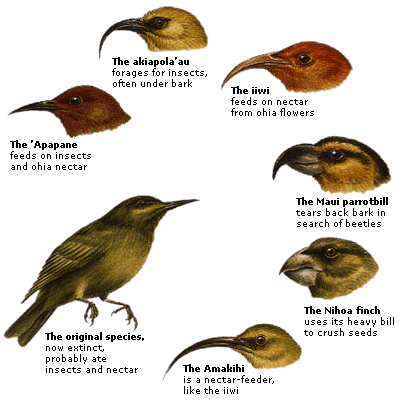
He noticed that the finches on the Galapagos Islands were indeed the same species, yet their beaks were different, on one island, the beaks were small, for catching insects, on other islands, they had larger beaks, for cracking nuts and fruit.